What Is 2 to the Power of 3 Over 2 Equal to?

Equality vs. disinterestedness — sure, the words share the aforementioned etymological roots, but the terms have 2 singled-out, yet interrelated, meanings. Most probable, you're more familiar with the term "equality" — or the state of existence equal. To achieve equality, a sameness of treatment should extend to all people, no affair their gender, race, ability, sexual orientation, class, and/or ethnicity, for example. Moreover, we often align equality with equal rights, admission and opportunities in addition to equal treatment.
"Disinterestedness," on the other hand, relates to justice, or proportional fairness. While many of us may recall of equity in terms of finances or business — similar having equity in a visitor — it has gained much more traction recently in the realms of social justice, civil rights and politics. In these areas, equity is about providing varying levels of support and aid to folks in club to level the playing field and, in the cease, achieve an equal outcome.
So, why tin't these terms be used interchangeably? Recollect of it this way: equality relates to sameness of treatment, but that sameness of handling does non always equate to "proportional fairness," or disinterestedness. Mental Floss puts it simply, noting that "equality has to practice with giving anybody the verbal same resources, whereas equity involves distributing resources based on the needs of the recipients."
Equality vs. Equity: The Push for Equity Isn't New — But It Is Needed Right Now
On an episode of NPR's On Betoken, host Meghna Chakrabarti explored the differences betwixt equity and equality in America, a conversation that was sparked, in part, by President Joe Biden's signing of an Executive Lodge titled "On Advancing Racial Equity and Support for Underserved Communities Through the Federal Government" dorsum in January 2021. While equity has been discussed, and while strides toward it have been fabricated in the past, the Biden Assistants has fabricated sure to mention the term quite a bit.
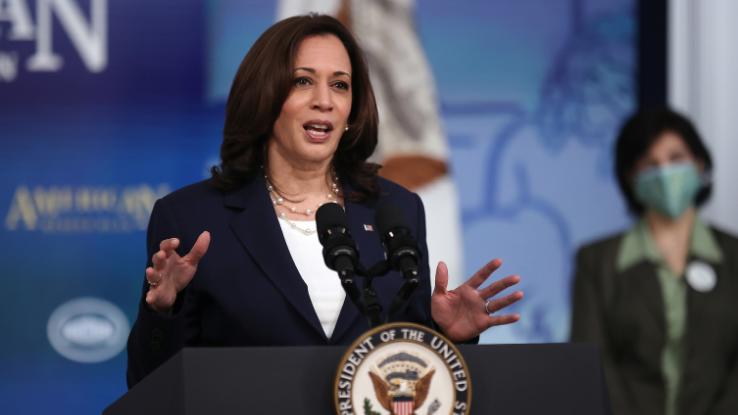
Soon later that Executive Gild was signed, Vice President Kamala Harris aimed to further clarify the differences between equality and equity — terms that cannot be used interchangeably, but, in practice, should happen side-by-side i another. "Yep, we want everyone to get an equal amount — that sounds right. But not everyone starts out from the same place. Some people start out on starting time base. Some people outset out on third base of operations," Vice President Harris explained. "And if the goal is truly near equality, it has to be about a goal of saying everybody should stop up in the same place, and, since we didn't beginning in the same place, some folks might need more — equitable distribution."
Chakrabarti delved further into Vice President Harris' explanation with On Point guest Robert Patterson, a professor of African American Studies at Georgetown University. Professor Patterson notes that it's difficult to discuss equity without outset bringing upward equality — and its shortcomings.
"[Equality] doesn't necessarily account for the present continuing that's sort of based on a history that has impacted where those people are," Professor Patterson explains on the podcast. "And so, when we remember of equity, by contrast, we're thinking nigh what are the resources that are needed that would account for, to Vice President Harris' point, different starting points… that would account for the aggregating of wealth… the accumulation of poverty, and how to … prescribe those resources in a fashion that the outcomes are like."
Created past the Interaction Found for Social Change and the Center for Story-based Strategy, the below graphic mayhap best illustrates the difference between equality and disinterestedness. In the image, three people of different heights want to sentry a game, only to find a argue obstructing their view. If at that place are three boxes to distribute, a methodology focused solely on equality would see each person receiving a box, regardless of their starting points (here, their varying heights). The event? The shortest person still can't come across the game despite the equal distribution of resource.
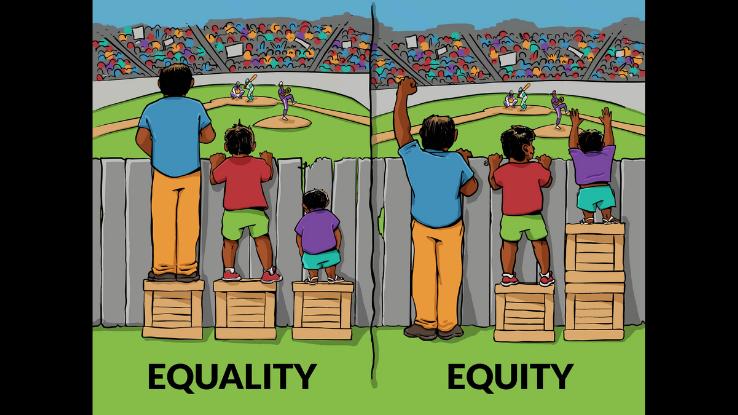
However, the equitable distribution of resource accounts for where these people start from. The tallest effigy can already see over the obstruction and, therefore, doesn't need a box, which allows for the other 2 people to receive the amount of boxes (or resources) they demand to see over the argue. The outcome? Although they all have a different amount of resource, all three people can now see over the obstruction and watch the game.
Equality means we all deserve, and should receive, the same admission, but, as illustrated above, disinterestedness helps to level the playing field to help achieve that outcome, that access. "To summarize," Mental Floss notes, "equality is about dividing resource in matching amounts, and disinterestedness focuses more on dividing resources proportionally to accomplish a fair outcome for those involved."
So, what'southward a real-word example of this deviation? Thoughtco. frames the deviation between equality and equity in a very digestible way. "Laws such as the Civil Rights Deed of 1964 provide equality," the publication notes, "while policies such as affirmative action provide equity." That is, while the Ceremonious Rights Human activity advocates for equality and equal treatment, something like affirmative action, an example of equitable distribution, acts every bit a ways of achieving that equality and ensuring a aforementioned, or like, result for all peoples, regardless of where they started or how systems historically oppressed and disenfranchised them.
In other words, equality is the outcome — that universal sameness — but equity accounts for the potential need for different access points, and so that those runners on first and 3rd, like in Vice President Harris' illustration, can both make it to home plate.
Source: https://www.reference.com/world-view/equality-important-4d4fef7c6633d22f?utm_content=params%3Ao%3D740005%26ad%3DdirN%26qo%3DserpIndex

Post a Comment for "What Is 2 to the Power of 3 Over 2 Equal to?"